
Published: April 7, 2026
Every business says it. "We meet our customers where they are." It's on landing pages, in pitch decks, in LinkedIn posts that get a polite handful of likes. But when a customer actually needs help? Most businesses funnel them into a single channel. Usually a portal login, sometimes a form, occasionally a phone queue that plays hold music from 2003.
We decided to do something about that.
Support, your way
Our client portal has always been the central hub for support tickets. You log in, raise a ticket, track progress, upload files. It works well. But we kept noticing the same pattern: a customer would get an email notification about a ticket update, want to fire back a quick "yes, approved" or "can you clarify that?" and then have to open their browser, log in, find the ticket, and type their reply there.
That's friction. And friction is where conversations go to die.
So we started asking: what if customers could just reply? From wherever they already are?
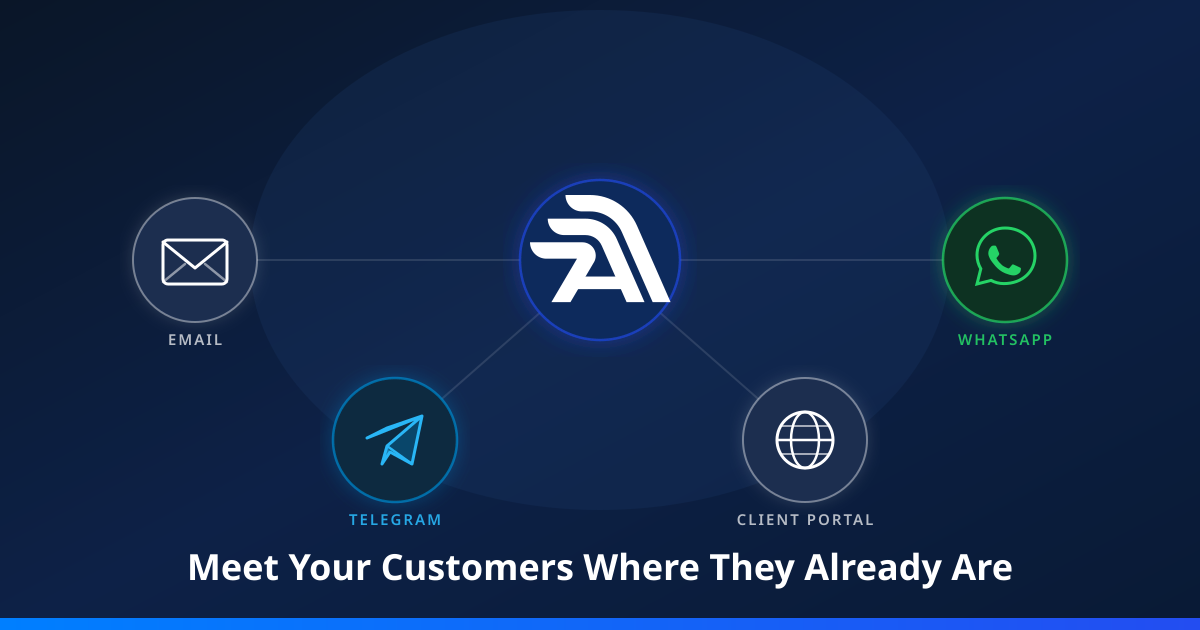
The channels
Email - When we reply to your ticket, you get an email notification. Now you can simply hit reply in your email client and your response lands straight back into the ticket. No login required. No portal. Just reply and carry on with your day.
WhatsApp - Prefer messaging? Raise a ticket via WhatsApp and the whole conversation stays there. Our team replies from the portal, you see it in WhatsApp. You reply in WhatsApp, we see it in the portal. It just works.
Telegram - Same idea, different app. If Telegram is your thing, your support conversation lives there. Send text, images, documents. All of it feeds into your ticket automatically.
The Client Portal - Still the home base. Every message from every channel converges here in a single, unified thread. Nothing gets lost, nothing gets duplicated. Your full support history, one place.
Why this matters
It's not really about having four channels. It's about having the right channel, whatever that means for each customer, in each moment.
A quick approval while you're on the train? Reply from your phone. A detailed brief with attachments? Use the portal. Something urgent while you're already in a WhatsApp conversation? Don't switch apps, just message us.
The point is: you shouldn't have to think about how to contact support. You should just contact support.
What it means for your team
If you're a business thinking about how your own support works, here's what we've learned from building this:
- Faster responses. When customers can reply from where they already are, they reply faster. Average response times drop significantly when you remove the "log in first" barrier.
- Unified view. Your support team doesn't need five apps open. Everything appears in one ticket thread. One conversation, one place.
- No context switching. Support agents work from a single interface. The customer chooses the channel; the team sees a unified inbox.
- Channel memory. The system remembers how each ticket started. If a customer raised their ticket via WhatsApp, replies route back through WhatsApp. No configuration needed.
The hidden details
We like to think of these as the small things that make a big difference:
- Reply to an email notification and your response is automatically cleaned up. Quoted text stripped, signatures removed, so only your actual reply appears in the ticket.
- Send an image via WhatsApp or Telegram and it's saved as an attachment on the ticket, accessible from the portal alongside everything else.
- If a ticket is closed and you reply via any channel, it automatically reopens. No need to raise a new one.
Support should be invisible
The best support experience is one where the customer barely notices the process. They have a question, they ask it however feels natural, and they get an answer. No hoops, no forms, no "please log in to continue."
That's what we've built. And honestly, watching customers discover they can just reply to an email and it works has been one of the most satisfying parts of this whole project.
If you're interested in how multi-channel support could work for your business, get in touch. We'd love to show you.