
Published: April 18, 2026 | Updated: April 19, 2026
Most businesses run on a patchwork of systems. Your ERP handles finance. Your e-commerce platform runs the shop. Mailchimp sends the newsletters. Shopify processes orders. Sage does the accounting.
Each one works fine on its own. But together? That is where the friction lives - manual data entry, copy-paste errors, and hours wasted each week moving information between tools that were never designed to talk to each other.
We built something to visualise the problem
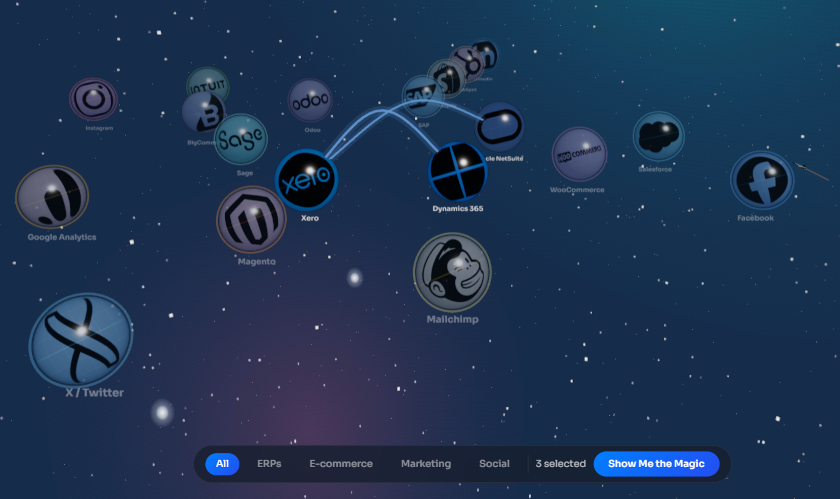
The Interactive Workflow Builder is a thought experiment you can actually play with. Pick the systems your business uses. Watch them appear in a 3D universe. See the connections form between them - not just the obvious ones, but the integration paths you might not have considered.
It is not a technical diagram. It is not a whiteboard sketch. It is an interactive experience that shows you what your integration landscape could look like.
Why a 3D universe?
Because integration is not flat. When Magento connects to Mailchimp and Sage and your CRM, those relationships are multi-dimensional. A flat list does not capture that complexity. A 3D space lets you see the web of connections as it really is - interconnected, layered, and full of potential.
Each system becomes a world in its own right. The connections between them are the trade routes - the pathways where data flows, automation saves time, and manual processes become unnecessary.
The magic is in the connections
There are over 100 integration rules built into the builder. Some are obvious - Shopify connects to Sage, WordPress connects to Mailchimp. But others might surprise you:
- WooCommerce → HubSpot: Sync customer purchase data directly into your CRM for better segmentation and follow-up sequences.
- SAP → Shopify: Push inventory and pricing from your ERP in real time, eliminating overselling and manual price updates.
- Google Analytics → Mailchimp: Feed engagement data back into your email marketing to improve targeting.
- Microsoft Dynamics → BigCommerce: Bridge your ERP and e-commerce platform so orders, customers, and products stay synchronised.
- Odoo → Slack: Automate notifications for key business events - new orders, low stock, invoice approvals.
Each connection represents hours of manual work eliminated. Multiply that across every system in your stack, and the time savings become significant.
What the numbers tell you
When you hit "Show Me the Magic", the builder calculates three metrics based on your selection:
- Integrations: How many actual connections exist between your chosen systems.
- Hours saved per week: An estimate of the manual effort those integrations eliminate.
- Automation percentage: How much of the data flow between those systems could be fully automated.
These are not abstract numbers. They are grounded in real integration patterns we have implemented for businesses across the UK.
A thought experiment with real implications
The Workflow Builder is not a sales tool - it is a way to think differently about your technology stack. Most business owners know they have integration gaps. They feel the friction every Monday morning when someone has to manually export a CSV from one system and import it into another.
But seeing those gaps visualised - seeing the connections that could exist - changes the conversation from "we should probably fix that someday" to "why are we not doing this now?"
Try it yourself
The Workflow Builder takes about two minutes. Pick the systems you use. Watch the connections form. See the numbers.
No sign-up required. No sales pitch. Just an interactive way to see what your business could look like when everything connects.
And if the numbers catch your attention - let's talk.